Sulfide oxidation and PTE release: successive H₂O₂ extractions versus simulated weathering
Abstract The acid mine drainage (AMD) resulting from sulfide oxidation is a severe environmental problem that elevates soluble concentrations of potentially toxic elements (PTEs). This study evaluated sulfide oxidation and acidity production in diverse matrices (pyrite, coal, thiomorphic soil, dolomite, shale, phyllite, alkaline, and ultramafic rocks) under two controlled weathering scenarios: a 357-day long-term weathering experiment and 13 successive extractions using 10% H 2 O 2 . Additionally, the effect of a CaCO 3 neutralization amendment in the sulfide-rich materials was tested. Samples...
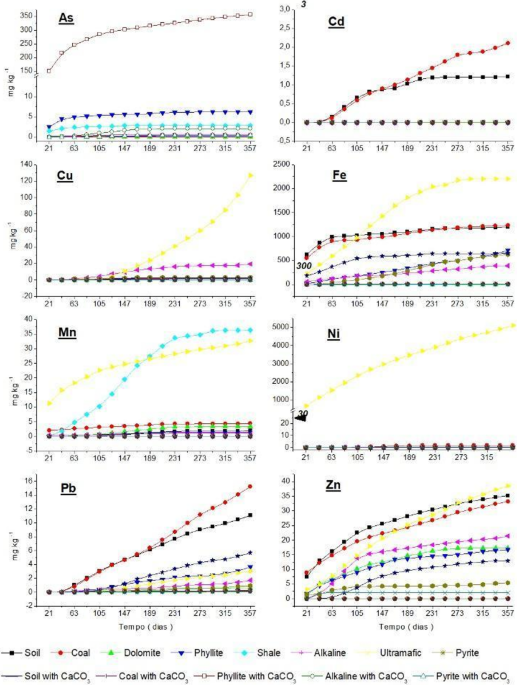
Abstract The acid mine drainage (AMD) resulting from sulfide oxidation is a severe environmental problem that elevates soluble concentrations of potentially toxic elements (PTEs). This study evaluated sulfide oxidation and acidity production in diverse matrices (pyrite, coal, thiomorphic soil, dolomite, shale, phyllite, alkaline, and ultramafic rocks) under two controlled weathering scenarios: a 357-day long-term weathering experiment and 13 successive extractions using 10% H 2 O 2 . Additionally, the effect of a CaCO 3 neutralization amendment in the sulfide-rich materials was tested. Samples were characterized for pH, total PTE contents, acid-base accounting, and 57 Fe Mössbauer spectroscopy. The results revealed that PTE mobilization followed the formation of oxidation products and was more strongly governed by matrix mineralogy and pH than by total elemental contents. Among the evaluated elements, Fe was the most abundantly mobilized. Furthermore, CaCO 3 amendment enhanced As mobilization, indicating its unsuitability for As-rich substrates. Regarding kinetic simulations, successive H 2 O 2 extractions reproduced more than one year of weathering for soil, coal, dolomite, shale, and ultramafic rock, whereas they simulated several years or decades for pyrite, phyllite, and alkaline rock. This discrepancy demonstrates the absence of a universal relationship between peroxide extraction steps and field weathering duration and suggests a future correction for organic carbon contents in solid matrices. In conclusion, this study highlights the high heterogeneity of sulfide-rich materials, underscoring the critical importance of considering each individual solid matrix rather than relying on standardized methods to predict acid drainage generation.
Imported from OpenAlex · View original