Thermally activated multistep alteration of Fe 2+ -bearing fluorophlogopite revealed by in situ Raman spectroscopy
Abstract. Elucidating the temperature-induced structural and crystallochemical transformations in phlogopite mineral species with a partial substitution of Fe2+ for Mg at the M(1,2) sites and OH-/F- occupancy disorder at the X site can help in better understanding the transport phenomena in the lithosphere and mantle metasomatism. Here we present the results from in situ temperature-dependent Raman spectroscopy on fluorophlogopite with Fe2+ content of ∼ 0.15 atoms per formula unit (apfu) and hydroxyl-group content of ∼ 0.40 apfu. A few heating–cooling runs were conducted in air up to different...
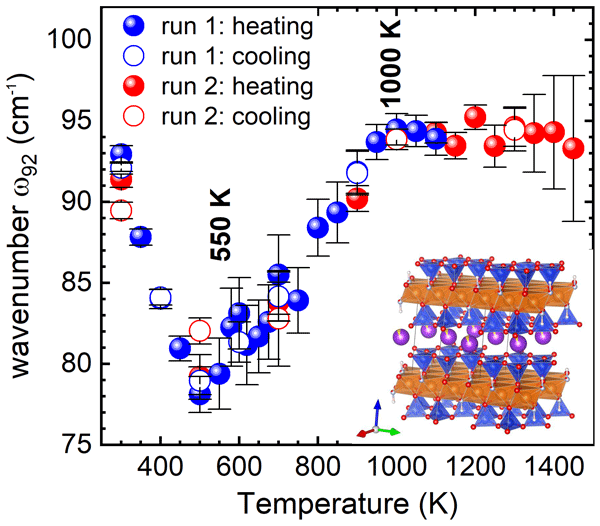
Abstract. Elucidating the temperature-induced structural and crystallochemical transformations in phlogopite mineral species with a partial substitution of Fe2+ for Mg at the M(1,2) sites and OH-/F- occupancy disorder at the X site can help in better understanding the transport phenomena in the lithosphere and mantle metasomatism. Here we present the results from in situ temperature-dependent Raman spectroscopy on fluorophlogopite with Fe2+ content of ∼ 0.15 atoms per formula unit (apfu) and hydroxyl-group content of ∼ 0.40 apfu. A few heating–cooling runs were conducted in air up to different temperatures, with the highest temperature achieved being 1450 K. The chemical composition and crystal structure before and after cooling down from 1450 K to room temperature were probed by wavelength-dispersive electron microprobe analysis (WD-EMPA) and single-crystal X-ray diffraction (XRD), respectively. The anomalies in the temperature dependencies of phonons reveal a sequence of heating-induced changes in phlogopite: (1) near 550–650 K structural instability related to interlayer interactions occurs, which activates the mobility of interlayer K+ cations. This process is reversible up to ∼ 1100 K, and, hence, diffusion of K+ can potentially contribute to phlogopite electrical conductivity between ∼ 650–1100 K. (2) At ∼ 1150 K all H+ cations delocalize, including those from OH groups linked to MgMgMg chemical configurations, and therefore can also act as charge carriers. (3) Between 1300 and 1450 K irreversible Fe2+ → Fe3+ oxidation develops, confirmed by a permanent resonance Raman-scattering signal after cooling down to room temperature, along with a subtle decrease in the unit-cell volume. Simultaneously, partial dehydrogenation and dehydroxylation take place as only 65 % of the hydroxyl groups recover at room temperature. The Raman-scattering data also suggest a minor loss of K+ (∼ 0.02 apfu) from the mica structure, whereas WD-EMPA indicates no change in the content of F− within uncertainties. A partial thermal decomposition of fluorophlogopite occurs above 1300 K, leading to the formation of a minor amount of nano-sized forsterite (∼ 1 % in volume), which nucleates mainly on the sample surface parallel to the cleavage plane.
Imported from Crossref · View original