
Structural controls on the subsurface fluid flow and seismicity after the 2014 eruption of Mt. Ontake, central Japan, inferred from dense seismic observations
Numerous studies have addressed the disastrous 2014 phreatic eruption of Mt. Ontake, central Japan, but limited studies have reported its post-eruptive activity. We report our latest analysis results of post-eruptive seismicity beneath the summit region of Mt. Ontake based on dense near-summit seismic observations since November 2017 and the latest subsurface velocity model. Long-term post-eruptive seismicity at a rate of several tens of events/month has continued for more than ten years, overlapped by unrest periods with more than ten events/day from February to March 2022 and from December 2...
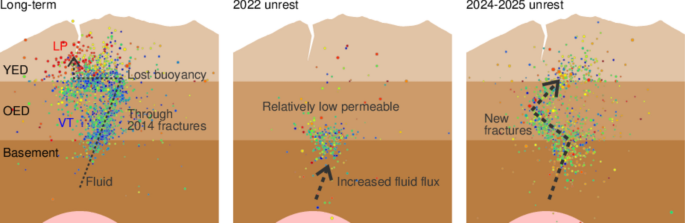
Numerous studies have addressed the disastrous 2014 phreatic eruption of Mt. Ontake, central Japan, but limited studies have reported its post-eruptive activity. We report our latest analysis results of post-eruptive seismicity beneath the summit region of Mt. Ontake based on dense near-summit seismic observations since November 2017 and the latest subsurface velocity model. Long-term post-eruptive seismicity at a rate of several tens of events/month has continued for more than ten years, overlapped by unrest periods with more than ten events/day from February to March 2022 and from December 2024 to January 2025. Extremely high seismicity rates of more than 30 events during several minutes (spasmodic bursts) on February 23, 2022, and January 21, 2025, were associated with a tremor, the largest earthquake in each unrest period, a very long period (VLP) event, and a tilt change. The seismicity was clustered at two elevations: one near the boundary between younger (< 0.1 Ma) and older (0.78–0.39 Ma) eruptive deposit layers (YED and OED, respectively) and the other near the boundary between the OED and the basement. Long-term seismicity occurred mainly near the YED–OED boundary, and seismicity during the unrest periods mainly occurred near the OED–basement boundary. The 2025 spasmodic burst involved the rapid migration of hypocenters from the OED–basement to YED–OED boundary. We modeled these features by the upward migration of volcanic fluids impeded by a relatively low permeability OED and a lost buoyancy at the groundwater surface immediately above the OED. The results were horizontal intrusions of fluids along the OED–basement to YED–OED boundaries, which may have caused pore-pressure increase and seismicity near the two boundaries. The 2025 spasmodic burst may have created new fractures in the OED, similar to the 2014 eruption, as revealed by changes in the spatial distribution of the hypocenters. These findings are essential to link the observation of seismicity with the subsurface flow of volcanic fluids beneath Mt. Ontake.
Imported from OpenAlex · View original