
Fluorine-induced melting in the Ihalainen calcite-wollastonite marble deposit, Lappeenranta, Finland
Abstract. Located adjacent to Lappeenranta in southeastern Finland, the Ihalainen marble deposit has operated continuously since 1910. Regional metamorphism of the calcitic and dolomitic marble of the Ihalainen Formation led to wollastonite formation, well dated at 1.86 Ga. At about 1.6 Ga, the area experienced intrusion by the Wiborg batholith of anorogenic granite with a rapakivi texture. Dikes of granite, composite basic–felsic dikes, and dikelets with an aplitic texture intruded into the wollastonite deposit, now part of a roof pendant, and caused localized fluxed melting of the ore. The g...
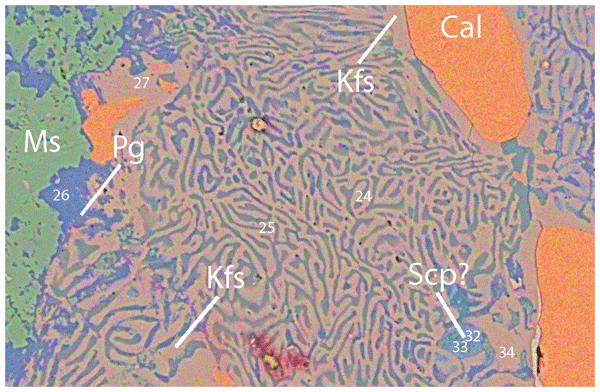
Abstract. Located adjacent to Lappeenranta in southeastern Finland, the Ihalainen marble deposit has operated continuously since 1910. Regional metamorphism of the calcitic and dolomitic marble of the Ihalainen Formation led to wollastonite formation, well dated at 1.86 Ga. At about 1.6 Ga, the area experienced intrusion by the Wiborg batholith of anorogenic granite with a rapakivi texture. Dikes of granite, composite basic–felsic dikes, and dikelets with an aplitic texture intruded into the wollastonite deposit, now part of a roof pendant, and caused localized fluxed melting of the ore. The gaseous transfer of CaF2 into the heated ore caused a very strange melt to form. It congealed quickly to forsterite, diopside, and graphically intergrown wollastonite + fluorite. Closer to the contact, an injection of geochemically evolved granitic melt induced anatexis of the marble. We investigated an emulsion of the two melts, one desilicated and now syenitic, the other a carbonate melt that contained dissolved silicates. The syenitic melt eventually crystallized to a sanidine solid-solution that underwent spinodal decomposition into two strained feldspars in the presence of a carbothermal fluid. A later influx of an aqueous fluid caused recrystallization of the feldspars but left intact the striking textural evidence of a once-coherent intergrowth. It also led to a bewildering array of calcic secondary minerals like pectolite, grosssular, holtstamite, and lawsomite. Three undescribed minerals in the affected rocks contain the high-field-strength elements Sn, Nb, and Ta.
Imported from Crossref · View original