
Material traces of a forgotten harbour: reconstructing the modern and contemporary history of Porto Clementino (Tarquinia) from historical mortar analysis
Abstract This study presents an investigation of historical mortars from Porto Clementino (Tarquinia, Latium, Italy), one of the most important commercial and military harbours along the Tyrrhenian coast during the eighteenth century, now largely preserved as archaeological remains. The research aims to characterise the mortars employed in the surviving pier structures in order to reconstruct the different construction and restoration phases, identify the provenance of the raw materials, and investigate the technological solutions adopted to enhance the durability of the harbour in a marine er...
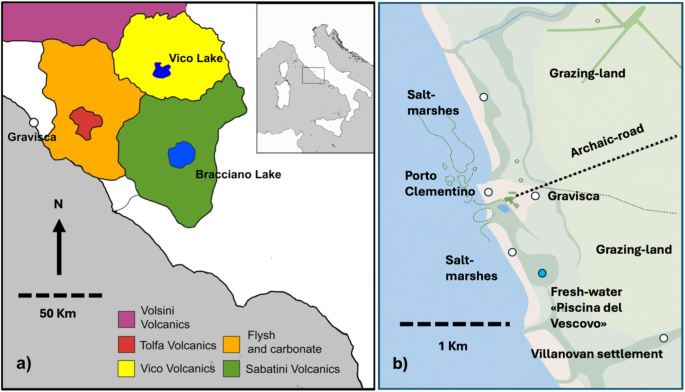
Abstract This study presents an investigation of historical mortars from Porto Clementino (Tarquinia, Latium, Italy), one of the most important commercial and military harbours along the Tyrrhenian coast during the eighteenth century, now largely preserved as archaeological remains. The research aims to characterise the mortars employed in the surviving pier structures in order to reconstruct the different construction and restoration phases, identify the provenance of the raw materials, and investigate the technological solutions adopted to enhance the durability of the harbour in a marine erosive environment. An interdisciplinary analytical approach was adopted, combining reflected- and polarized-light microscopy, field-emission scanning electron microscopy coupled with energy-dispersive X-ray spectroscopy (FE-SEM-EDS), X-ray powder diffraction with Rietveld quantitative phase analysis (XRPD-QPA), and thermogravimetric analysis (TG). These complementary techniques enabled a comprehensive petrographic, mineralogical, and microchemical characterization of both the binders and the pozzolanic aggregates. The results provide new insights into the composition and provenance of eighteenth-century hydraulic mortars and reveal widespread Mg enrichment within several binder phases. This enrichment is interpreted as the result of one, or a combination, of three mechanisms: the use of magnesian lime during construction, long-term seawater-driven mineralogical alteration of the hydraulic binder, and the progressive weathering of Mg-bearing volcanic aggregates, particularly clinopyroxenes, releasing magnesium into the surrounding matrix.
Imported from OpenAlex · View original