
Comparisons between non-destructive and destructive XRF chemical analyses on an extensive group of vitreous and aphyric volcanic rocks from the Jemez Mountains region, New Mexico, USA
Abstract Non-destructive surface exposure (EDXRF) analyses for major and trace elements are widely used in archaeological investigations to characterize sources of artifacts and stone tools because these methods provide geochemical information on objects that usually cannot be destroyed. However, EDXRF methods are not used in most geological investigations where sample destruction is the norm. Thus, a variety of destructive whole rock chemical methods are relied upon for geoscientific research within geochemistry, volcanology, petrology, etc. In this paper, we examine the utility of benchtop E...
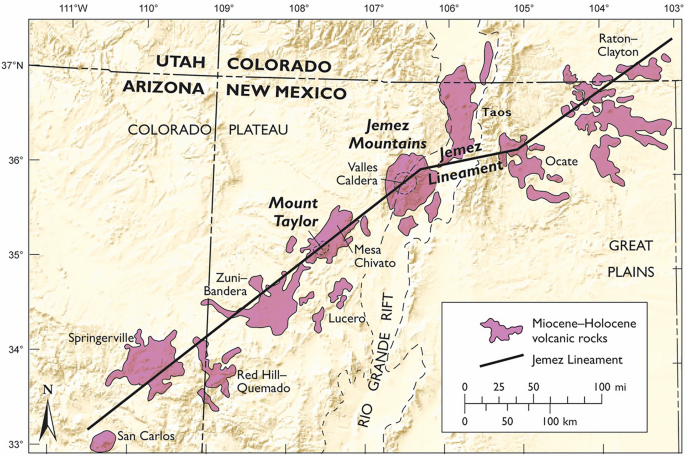
Abstract Non-destructive surface exposure (EDXRF) analyses for major and trace elements are widely used in archaeological investigations to characterize sources of artifacts and stone tools because these methods provide geochemical information on objects that usually cannot be destroyed. However, EDXRF methods are not used in most geological investigations where sample destruction is the norm. Thus, a variety of destructive whole rock chemical methods are relied upon for geoscientific research within geochemistry, volcanology, petrology, etc. In this paper, we examine the utility of benchtop EDXRF as a rapid and relatively inexpensive analytical method to correlate volcanic rocks in a variety of geological and archaeological situations and investigations. We compare EDXRF and WDXRF analytical results on four groups of Late Neogene through Quaternary volcanic rocks from the Jemez Mountains region: 1) Cerro del Medio obsidian, rhyolite, and pumice, 2) upper flow units of Tshirege Member, Bandelier Tuff, 3) porphyritic lavas from Rendija Canyon rhyodacite and pumiceous beds in the Puye Formation, and 4) vitreous and aphyric dacites and a basalt from various locations. Standard major element analyses by EDXRF and WDXRF methods are relatively comparable for glassy silicic rocks like rhyolite (e.g., ≤ 2 wt% difference in SiO 2 , ≤ 3 wt% difference in CaO, etc.) but less so for more mafic compositions because the former method underestimates the contents of MgO and P 2 O 5 . Problems with major element EDXRF analyses also occur with vesiculated pumice and rough, highly porphyritic specimens because sample surfaces are porous and/or uneven. On the other hand, we compared nine trace elements (Ba, Nb, Pb, Rb, Sr, Th, Y, Zr, and Zn) analyzed by both methods and results are generally comparable (usually ± 10% on ppm basis) for most rock compositions and textures. The most reliable trace elemental comparisons for all rocks we analyzed were with Ba, Nb, Rb, Sr, Y, and Zr.
Imported from OpenAlex · View original