Building stones of the Val di Noto Baroque monuments (Sicily, Italy): multi-scale evaluation of durability in Ragusa and Modica limestones
Abstract The Ragusa and Modica limestones, two lithofacies of the Ragusa Formation widely used in the Baroque architecture of southeastern Sicily, are susceptible to deterioration phenomena such as efflorescence, alveolization, detachment, and biological colonization. This study examines their petrographic and physico-mechanical properties to ascertain how their structure influences the weathering behaviour. Although both stones share a mainly microsparitic matrix, and show evidence of bioturbation, the Modica limestone displays more pervasive heterogeneities, which reduce its compactness and...
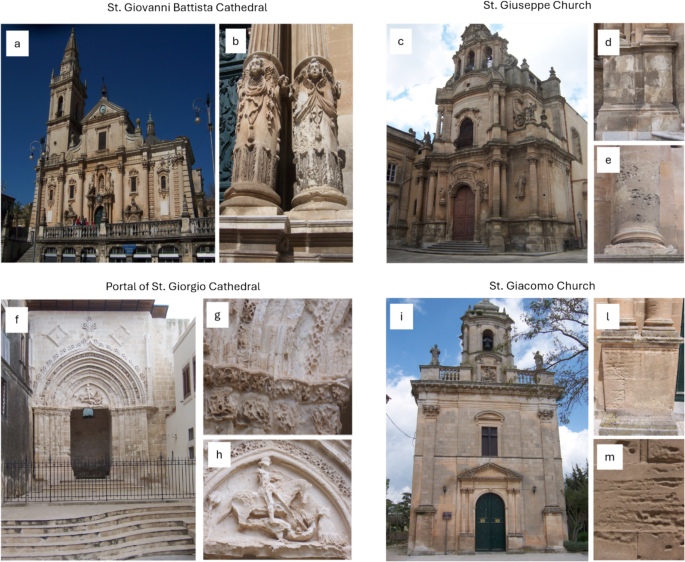
Abstract The Ragusa and Modica limestones, two lithofacies of the Ragusa Formation widely used in the Baroque architecture of southeastern Sicily, are susceptible to deterioration phenomena such as efflorescence, alveolization, detachment, and biological colonization. This study examines their petrographic and physico-mechanical properties to ascertain how their structure influences the weathering behaviour. Although both stones share a mainly microsparitic matrix, and show evidence of bioturbation, the Modica limestone displays more pervasive heterogeneities, which reduce its compactness and mechanical strength. These features enhance pore connectivity and increase its susceptibility to salt-related degradation. Ragusa stone, in contrast, exhibits a more homogeneous structure and better overall performance. The results are compared with other Hyblean carbonate lithotypes also used as building materials in the same area. This broader framework provides new insights into the suitability and conservation needs of these stones within historical architectural heritage.
Imported from OpenAlex · View original